
One unit, four panels, each tracked on its own
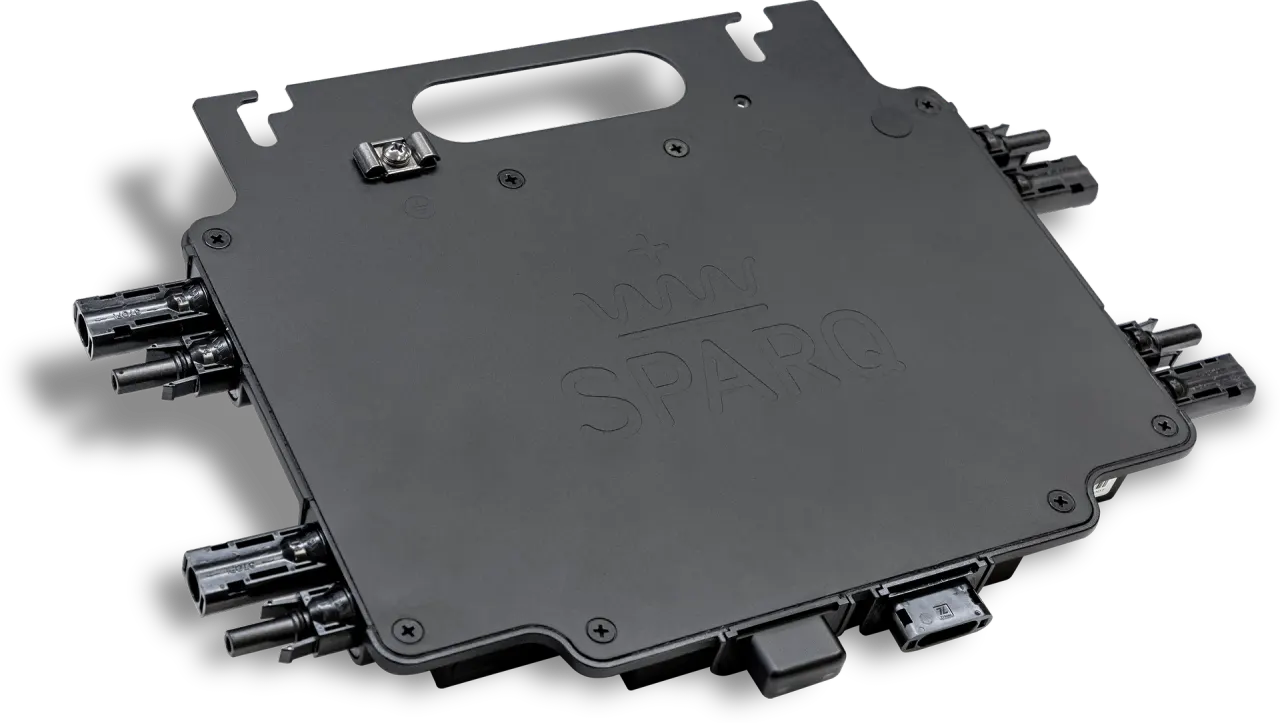
A Sparq Quad gives each of its four panels its own maximum-power tracking, with no electrolytic capacitors and all-AC output. This page shows how it works and what it changes on the roof.
Drag a cloud. Watch the difference.
A conventional string inverter wires panels in series: shade one, and the whole string drops to the weakest panel. The Quad tracks each panel independently. Try it.
Simplified model for illustration, not a performance guarantee. Irradiance per panel from cloud and shadow coverage; bypass diodes are modelled on both sides (each panel is three diode-protected cell-strings; the string inverter and the Quad each run maximum-power tracking over them, checked against the open pvlib single-diode model). Under a hard shadow the two can read nearly equal. The Quad pulls ahead under soft, uneven shade (a cloud edge), where a series string is dragged to its weakest cell-string and per-panel tracking is not. Identical conversion efficiency on both sides. Cut the grid shows a grid-tied string inverter shutting down; the Quad's dual-mode output is not modelled. A leaf on one cell-string costs that panel ~40%; haze dims every panel evenly (both systems fall together, the comparison isolates shade, not weather); the chimney shades the west panel through the afternoon.
Three ways to wire eight panels
Move the shade. On shade the Quad and a one-per-panel microinverter behave the same, and the drawing says so. What differs is the count of things to mount, commission, monitor and warranty.
Three ways to wire eight panels.
Same roof, same eight panels, three architectures. Move the shade to see which panels stay independent — then look at how much hardware is on the roof to get there.
The honest part: on shade, the Quad and the one‑per‑panel microinverter do the same thing — every panel is tracked on its own, so a shaded panel costs you that panel and nothing more. That is a tie, and we say so. The difference is the roof: two units instead of eight, a quarter of the parts to mount, commission, monitor and warranty — for the same per‑panel tracking.
Eight panels in a 2×4 array. Panels per tracker is the architectural figure: a Quad carries four independent MPPT channels in one unit, a microinverter carries one, a string inverter tracks the whole series at once. Voltage classes are architectural, not a product rating. The shade control shows electrical independence only; it does not predict energy yield.
Design life vs. warranty vs. the part that usually quits first
A panel is built to run for 25 years.
The Quad is designed to match it.
Drag the line below. Watch what a quarter-century actually does to the part inside the box, and where the weak link sits in a typical inverter today.
Drag anywhere on the board, left to right, 0 to 25 years.
Interactive timeline unavailable in this browser, no scripting detected.
The claim, plainly stated: a solar panel carries a 25-year design life. Most competing inverters use electrolytic capacitors for internal energy storage, and those capacitors, along with cooling fans, are commonly the first parts to fail, often before the panels do. SPARQ's inverters are built without electrolytic capacitors, with components matched to the panel's 25-year design life. SPARQ's standard warranty is 12 years, extendable up to 25.
Price · performance
The best way to build solar is 5% of the market.
Not because it doesn't work. Because of what it costs. Microinverters are more fault tolerant and safer than the alternatives — and that has never been the argument. Price has.
A fundamentally different approach
While competitive inverter companies build on conventional hardware-based topologies, Sparq builds long-lasting hardware driven by software-based algorithms.
Quad architecture
One microinverter, four PV panels, four independent DC input channels: individual peak-power tracking per panel with a fraction of the hardware.
Software-defined MPPT
Maximum-power-point tracking runs on each panel independently as cloud, shade and load change, so a shaded panel costs you that panel and not its neighbours.
Quad2 / Quad3 datasheet: 97.5% peak, 97% CEC, 99.85% static MPPT.
Electrolytic-capacitor-free
The failure-prone electrolytic capacitor is engineered out entirely. Long-life components matched to the panels' 25-year design life, and one unit failing doesn't take down the rest of the array: a string fault takes the array offline, a Quad fault affects its own four panels. The warranty is a separate number.
What is on the roof, in volts
Because each panel gets its own tracker, the DC on the roof stays at panel level, about 40 to 60 V per channel. A series string carries roughly 400 to 700 V of DC across the same roof, depending on string length. Same array, two very different things to work near.
Native three-phase
Quad3 delivers native three-phase output, so no external phase balancing is needed for commercial and industrial arrays.
The Silicon Road
Today a microinverter converts power with discrete semiconductors: individual parts, placed and soldered onto a board. We're working to integrate those parts into a power semiconductor chip set. Below, the board on the left is built. Everything to the right of it is drawn. Drag along the road and watch the ink run out.
- Low-voltage power module
- High-voltage power module
- DC-side control
- AC-side control
- Optical isolation
- Ferrite cores
The board is drawn solid because it exists. The chip set is drawn hollow because it does not. Block names are those given in the investor deck's chipset diagram, slides 19–20.
What ships today
Power conversion performed by discrete power semiconductors on a board. Real hardware, in the field, doing the work.
Because each function needs its own part, the bill of materials has a floor. Cost and performance are limited by that, and the floor cannot be lowered much further without integrating the parts.
Investor deck, slides 19–20 · Beacon Securities, p.8Components already removed
We have already eliminated a substantial number of components, including electrolytic capacitors, a key point of failure.
We haven't published a count yet.
Investor deck, slides 19–20 · figure not disclosedWhat is not built
The chip set. Its blocks are named and its direction is stated. There is no silicon, no sample, and no date attached to it.
Everything to the right of the board in the drawing above is an outline, and it stays an outline no matter how far you push the handle.
Investor deck, slides 19–20 · in developmentHardware is half the story
SparqLinq commissions and connects the array. SparqVu watches every panel from the web. SparqSync puts it in your pocket.
SparqLinq
Panel-level metrics and historical records. View in a browser with SparqVu, or on your phone with SparqSync.
Web monitoringSparqVu
Multi-site performance management with intuitive displays; spot issues and troubleshoot from anywhere.
MobileSparqSync
Energy data, alerts, weather and per-inverter details, on your phone.